LinkedIn

View Rajesh Mohandas's profile on LinkedIn
Showing posts with label Lean Six Sigma. Show all posts

Monday, May 9, 2016

3 value propositions to address the Top 10 CIO Concerns


Lean IT is the extension of lean manufacturing and lean services principles to the development and management of information technology (IT) products and services. Its central concern, applied in the context of IT, is the elimination of waste, where waste is work that adds no value to a product or service.

Enterprise Architecture (EA) is a conceptual blueprint that defines the structure and operation of an organization. The intent of enterprise architecture is to determine how an organization can most effectively achieve its current and future objectives. SMACT stack is a new enterprise IT model that blends social, mobile, data analytics, cloud technologies and Internet of Things to improve business competitiveness.

A survey from Forbes pointed out the Top 10 CIO concerns as follows:
  • -       Technology Alignment with the Business
  • -       Security & Privacy
  • -       Speed of IT Delivery and Time-to-Market
  • -       Innovation
  • -       Business Productivity & Efficiency
  • -       IT Value Proposition to the Business
  • -       IT Agility & Flexibility
  • -       IT Cost Reduction & Controls
  • -       Business Agility & Flexibility
  • -       Business Cost Reduction & Controls

With close to 15+ years in my consulting tenure practicing Lean Six Sigma with Enterprise Architecture now embracing next generation digital wave of SMAC IoT here are top 3 things an enterprise should switch to or start thinking to address the above concerns:

1.    Think First … Think Fast… Think Future
-       The ever changing landscape of business and technology poses a challenge for any big or small enterprise to catch up with the speed and scale, its very crucial for the technologist to play a vital consulting role in alignment with business and management in clearly defining the roadmap of the future. Here is where the role of an enterprise architect becomes important to align the Big 7 areas (MDM, BPM, ECM, IDM, UXM, BI and Middleware) clearly mapping the big 5 architecture components : Business Architecture, Information Architecture, Integration Architecture, Data Architecture and Application architecture leveraging the latest digital technology stack Social, Mobile, Analytics, Cloud and Internet of Things

2.    Lean Before Digitize
-       Lean Leader becomes an integral part of the core team who will define the areas to go Lean and help Specify value from the standpoint of the end customer by product family, clearly eliminate non value add and perhaps automate and orchestrate value enabling activities. As flow is introduced, let customers pull value from the next upstream activity and aim at creating perfection in all the areas. An enterprise architect wearing a lean cap will play a very crucial role at all levels of architecture ensuring agility, flexibility, scalability and reusability with least efforts and almost zero rework keeping in mind the pace of technology change. Lean and Six Sigma are proven frameworks of excellence and cost optimization as a result of improved operations / decisions impacting business productivity and efficiency 

3.    Empower… Engage… Energize
-       The people factor will play an equally crucial role in the millennial era, the employees need to see value in what they are doing if not what will be left over in the organization will be those who will end up dreaming the future unable to execute, many a organizations have not matured to the modern day thinking, the HR policies and the complacency mind-set equating presence with performance and no moonlighting will kill innovation. What is required is to enable the talent in the organization to stand on their own feet and think like entrepreneurs, empower with strong HR policies which energies the employees to engage in the next gen digital wave and contribute towards the organization growth. Get away from reporting employee utilization  by measuring 9 to 6 stay and work in office / timesheet entries and feel proud that your utilization is increased and for haven sake stop force fitting your talent into the bell curve … this will force employees not to take risk fearing missing the goals and objective.

For every organization to be successful remember all three areas People, Process and Technology are extremely important, the next generation digital wave marked with the SMACT stack will need skills that are not coming out from the education factory (Engineering and Tech. institutes) hold your best talent… groom them to see the future and get ready for the future…

Lean Six Sigma philosophy applied with Enterprise Architecture Frameworks in the SMACT area and harnessing the talent to its fullest potential with right policy governance is a mantra of the millennial organization that foresees itself to stay competitive in this market …


Tuesday, February 18, 2014

Exploring a Roadmap to $ 100 Million Corporate Excellence …

Organizations today have evolved and with all the expertise and years of experience making leaders fascinated to theories of Six Sigma built during 1980’s and try to replicate something similar to knock the door of an overlooked opportunity…

Large transformation and cost optimization thru change projects cannot be accomplished only with incremental efforts although they are very important to build the organization DNA, breakthrough improvement should be the focus and grab all opportunities with both hands wide open…
My objective was to go beyond the orthodox methods and focus on experiments, unless one experiments with various models it’s very difficult to get the breakthrough. Conceptually I found everyone in agreement with my proposal to experiment and hardly anyone agreeing to budget and fund it … alas … have I wished I was elsewhere … nonetheless I did not lose heart and continued to play more of a sales man role instead with a focus to get the budget for experimenting.

With a lot of travels and a series of meetings I found a cloud with a silver lining and the hope grew positive as I finally found one person to invest in my pilot.
Excited with the initial investment and support I set forth with the plans in place just to meet the end very soon and saw the initiative reaching its unexpected failure…, things did not go as planned and money wasted… I almost lost faith and my face value only to find the sponsor is interested in the idea and wanted to fund more … Surprise Surprise … ! … Thank god… my days look bright…

I did find an interesting and matured leader who joined hands to champion the efforts as a co-owned project execution being a strong promoter… we started it all over again and this time all the knots tied with roles and responsibilities not only aligned but tracked … the team members were from lower bands much hands on SMEs unlike the leadership bands who we had on our team previously, we had a very different strategy and focus was on straight forward execution instead of a traditional approach of gathering buy in and selling the idea … engagement etc… it was very clear… either do what is told or look at different opportunities for yourself.., a lot of strong decisions were taken and of course there were people who got irked and watched us with eyebrows raised… three months of the pilot and from the fourth month we started to see the results … overwhelmed we started to dream if this can be extrapolated across the organization we will easily make a savings of $ 23 Million YOY … multiplication is a very good mathematical application and in all practical purposes should not be used loosely… our experiences held us back and reminded it’s only the pilot which is successful … now with this success we should go to the world out there to build momentum  and gather buy in… 
Unlike me there are lot of people bubbling with energy, top leaders with more experience than me and not to be surprised while I find my creativity God’s Gift there are few leaders who consider themselves as God. Manoeuvring thru the egos and ethos proving people with a lot of case studies, Industry best practices and expert transcripts helped me propose a structure to be put in place and projects be picked up which will help accomplish the goal… while traditional Lean and Six Sigma team will continue to focus on incremental improvements and cycle time improvement where the gains are intangible and notional we will need another team focusing on accelerating the Change … the real multi dollar gains will come from large transformational projects using the principles of TRIZ coupled with tools of Lean Six Sigma and change acceleration. The thought process was very simple … address the wants instead of the need…!


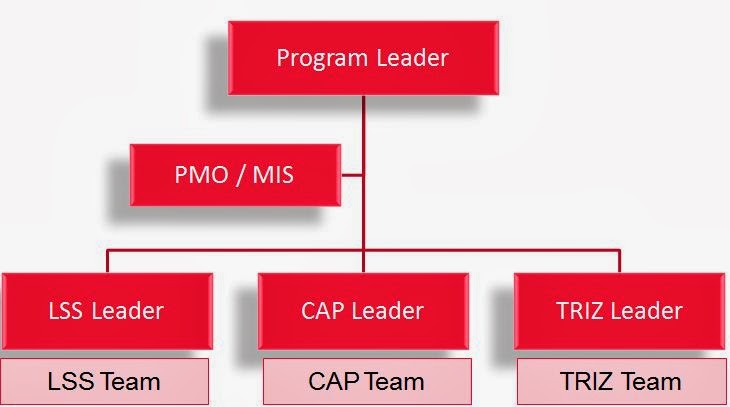
With the key pillars and approaches identified, I moved on proposing the team structure. This is the most important part of the proposal; while I was clear that each of the pillars be run by a separate leader and roll up to the program there were few suggestions which were of an all-rounder approach… every one doing everything. I don’t deny this approach, but at least in the initial stages it is important to establish clarity and set the right direction and I chose the following team structure.
  

 Once we have the team and concepts agreed approved stamped and communicated and get the house in order … the next step is to connect with folks at the CxO level to brainstorm ideas for larger transformations… while at the downstream similar brainstorming will continue at all levels till the bottom node to identify areas of improvement …

Monday, February 3, 2014

EBITDA and SG&A Improvement… the cash flow story (Part 1)


26th June 2013, the day two giant IT Companies merged officially and the market stopped tracking Mahindra Satyam and the only entity continued to exist is TechMahindra.

This was the day I took over a role as a Sr. Consultant in the business and process space to contribute towards driving continuous improvement projects to enable free cash flow thus improve the EBITDA (earnings before interest, taxes, depreciation, and amortization) … one of the most critical measure of the company's valuation tracked in the capital markets by the financial experts.
As a first step we spent time with the business leaders who looked to maximize the return on investments evaluate impact of operating the business on free cash flow. In an environment of maximizing value, it was important to review all business expenses and conduct a profitability analysis across all the projects. In so doing we discovered at the project level the contributors who impact EBITDA, which increases the value of your business and the ones who are pulling it down. As a next step I and my team lead by the best of the leadership worked hard to help understand sales, general, and administrative (SG&A) and look to maximize those costs as a percentage of revenue.

 It’s a known fact that High operating costs lower your EBITDA… one of the things that I have done in the past is to quickly identify all value enabling activities and digitize them those that will need people involvement outsource them to low cost channels. I carry a very strong philosophy from my past experience that my people will work only on the value added tasks and process rest all value enabling tasks be outsourced and kill the non-value add. The first few suggestion made people hesitant to entertain the idea of lowering operating costs because they immediately equate it with lying off employees. It took quite some time to educate the crowd that there are a lot of other ways to lower your operating costs without reducing staff. Could be as simple as turning off your machines and lights to save energy, wastage of food and the network usage to start with the journey of Lean following the principles of HoShin KanRi and go with the policy implementation.
Ideas and best practices picked up from the experience of the past helped spin a quick fix just do it kind of projects around Cycle time improvement that directly impacts billability. Two teams were given tasks to build the six sigma culture as a DNA in the organization.  8 – 10 leaders in a consulting role attached themselves with each business group.

I owned the entire set of support functions and kicked off the improvement path by checking for areas of inefficiency that can be corrected with new policies and procedures … focus was to be lean and quick on the solution front without spending a lot of time on data collection and data analysis, because it’s a known issues to all just an as is process / value stream map is good enough to identify waste and eliminate it strengthening policies and procedures.
Wing to Wing financial analysis of each support function opened a wide set of opportunities to focus up on… Cab usage, arrival pattern and employee commutation costs were identified to fix asap and then engaged a team from facilities to pull down the power tariff and work towards improving efficiency on energy usage. Companies like GE and Philips were consulted and engaged in the solutioning and implementation of ideas.

Visa Cycle time and Air Travel was another big ticket item that was looked at. No doubt that a growing company will have a growing spend on the travel and the ticket prices are equally volaitile, but there were a lot of opportunities like blocking the ticket 6 hours in advance, reducing approval cycle time w.r.t. travel request, choice of travel class (Economy / Business), Travel mode like Air, Road or Train, effective use of technology like telepresence and video conferencing, strengthened planning to reduce the last minute cancellations, overcome date changes in travel. Policies governing around international travel and the per diems associated etc… accounted a good round of savings.
Infrastructure spend was another big-ticket item on the list which owned a lion’s share of the budget, with growth comes the overheads related to network and datacentres, storage and spend on TSP. Reducing the call volume and number of service requests was another area that improved productivity, reducing the approval cycle time and simplifying the approval matrix made the operations lean.

Projects were spinned around DSO… days out standing … the accounts payable and receivable cycle time, employee reimbursements, finance ERPs, invoicing defects and delays and wing to wing cycle time at the collections front added more savings and directly impacted the bottom-line which was an icing on the cake resolving quite a good amount of issues related to the cash flow.
Optimizing the wing to wing resource supply chain and hiring cycle time, enabling ease w.r.t. joining formalities made life more comfortable adding at least 35 days of additional billability and improving the revenue stream added a new flavour all together to the program.

While you have read the positives and the things done we encountered a situation where like any other company the execution looked bleak, as long as there was focus things were moving and as the focus shifted there variation crept in. IT Systems and structures did not help much. Performance targets were poorly defined we lacked insights into the long term levers, while the near term picture looked great there were concerns around the sustainability and long term results were questionable.
This is a time when we looked like being exhausted with the ideas and best practice picked up from the market and most of the things already implemented, there was nothing new to identify from a cost optimization whereas there were a lot of opportunities around cycle time improvement that will lead only to notional cost compared to hard savings that could impact the bottom line.

It was a time to rethink on what I was actually doing, initial enthusiasm and quick fix projects from the past experience will not help in the long term and I need to now strike the right balance between targeted reductions, re-allocation and re-investment in areas that can driver higher overall expense productivity over time. It was very important to establish benchmarks that are truly “apples-to-apples” and start looking at highly-granular spending breakdowns; more importantly clear understanding of the strategic, tactical and organizational “drivers” of world-class cost structure performance is something I started to focus up on.

Days passed by and a series of brainstorming session threw light on prioritizing the strategic goals, relooking at the degree of centralization and empowerment to local teams, funding mechanisms, vendor rationalization, realigning roles and responsibilities, hierarchy … head to tail ratios, opportunities of outsourcing as a new set of projects to focus up on in the coming year….

While the first year was a cake walk with quite a good amount of savings making the bottom-line healthier and reaching the set goal, it’s in this coming fiscal that a lot of people in raising eyebrows to ideas being brainstormed and extending surface level … people involved at middle and lower management feeling insecure as soon as talks w.r.t. outsourcing and role rationalization were being discussed … nonetheless a lot of support from the Sr. Management is adding a lot of confidence to the program and the determined will and focus is helping me overcome all hurdles and moving forward to accomplish the goal…  truely a great expriance and awesome company to work with :-)